Information & ServicesLibrary
Mission Statement
Our mission is to provide students, faculty, and staff of Midland College with a safe, inclusive, and collaborative space where all individuals can contribute to the academic and general knowledge of our community. We are dedicated to supporting the academic and technical offerings of Midland College by providing access to current and curated physical and online materials that align with our institution's goals.
We strive to empower our students with the skills necessary for effective use of information resources, critical evaluation, and research. Through personalized instruction and research assistance, we guide students, faculty, and staff in navigating the vast array of information sources, fostering information literacy and promoting ethical use of knowledge.
Our comprehensive services encompass a wide range of resources, including books, journals, databases, interlibrary loan, digital resources, and technology assistance. We are committed to fostering intellectual growth, lifelong learning, and personal development within an environment that promotes equity, diversity, and inclusion.
Together, we cultivate an enriching academic experience, empowering our community to succeed in their educational pursuits, research endeavors, and pursuit of knowledge.
Midland College Mission Statement
More About the Library
Select Links Below for More Details
The MC Library is located on the ground floor of the Murray Fasken Learning Resource building, and contains the physical resource collection, patron-access computers, designated study areas, and designated lounge areas.
Basic Services
As a circulating academic library, the MC Library’s layout is designed to present the physical collection for patrons to peruse and check out from as well as provide study/collaboration spaces for study and course assignments:
- 31 ranges of books organized according to the Library of Congress Classification
- 54 tables spread out around the ground floor for studying/collaboration work
- 2 semi-private study cubicles along the North wall (no reservations)
- 4-5 areas for lounging
- 34 desktop computers
- 17 laptop computers
- For more information about the Library’s computers, go to LRC Computer Resources
If patrons prefer to use personal devices, they can connect to the College’s Wi-Fi network:
- Network Name: MCGUEST
- Password: guestaccess
Note: This is a public-access node, so all users are asked to utilize best practices for computer safety and hygiene.
The MC Library offers access to a stand-along black-and-white copier/printer/scanner, located behind the Circulation Desk. All desktop computers are networked to it as a printer, it can accept PDF documents via a thumb drive for printing, and patrons can scan documents to a thumb drive from it. Any staff member can help walk patrons through the process.
Primary Staff
- Stephanie Shedd, Director of Library Services, sshedd@midland.edu
- Brianna Barnard, Technical Services Librarian, bbarnard@midland.edu
- Georgia Pisklak, E-Resources Librarian, gpisklak@midland.edu
- William Cookman, Head Reference Librarian,wcookman@midland.edu
- Mari Menix, Student Liaison, mmenix@midland.edu
Main Phone Number
(432) 685-4560
Connect With Us
Additional Services
As part of the Library’s goal to be a resource for the College and community, it provides these additional services.
Friends of the Library Book Annex
In the front foyer are two book cases and a small table for overflow books from Friends of the Library (FOTL). Upon request, the volunteers from FOTL will bring surplus books from their resale store that they think would be of interest to students. The inventory should rotate every 2-3 weeks. If you are interested about the FOTL store, please go to their website.
Midland Friends of Libraries and Literacy Bookstore
Pink Pantry
The Library will maintain a Pink Pantry, which is a community initiative providing free feminine hygiene products to fight period poverty and stigma.
- Stocking and Usage Guidelines:
The pantry will primarily stock menstrual products (pads, tampons, liners, menstrual cups). - The pantry will only provide sealed, unexpired, and new items. No medication (not even aspirin) will be offered.
- When donated, the pantry will include other basic hygiene items like wipes or personal care products if space permits.
- The pantry will not accept or offer damaged goods, opened packages, or expired items.
- The pantry will be maintained in the first-floor women’s restroom to ensure that it remains a respectful, safe space.
Plant Wall
In the Southwest corner of the Library, there is a wall display of indoor plants for patrons to enjoy and learn from. The plants on display are common indoor plants that are considered beginner friendly, so patrons are encouraged to ask about them since the Library staff are the ones cultivated the display. Information about the plants, help with troubleshooting personal gardens, and access to occasional cuttings are available upon request.
Miscellany
- Decorations: Since the Library is a growing project, patrons will happily discover new and expanding décor not only on the walls but among the stacks. Exploration is strongly encouraged.
- Red Panda: There is a spirit animal among the stacks, usually reading a book or two for the staff who tend to be too busy to read as much as they would like. She is very friendly and will happily share recommendations of her favorite books.
- Fred the Building Ghost: As is true with any building that has been around a decade or two, the LRC Building has a ghost. Generally, Fred is rather easygoing and benign; however, if he feels that harm is being done to the Library, he can become less benign.
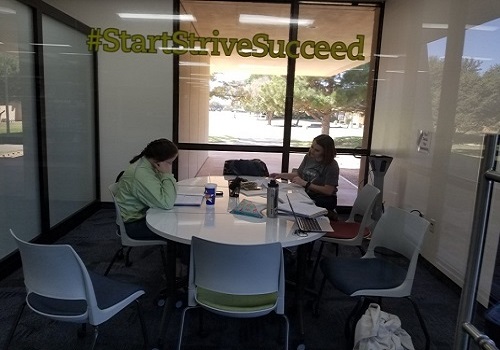
Our study rooms offer enclosed study areas, collaborative technology, accessible power options and whiteboard walls and tables. They are available on a first-come, first-served basis.
STUDY ROOM AFeatures a large work table suitable for either a small group or individual. This room is designed for flexible study both with and without mobile technology.
|
STUDY ROOM BFeatures a U-shaped table bookended by a large screen supporting laptop connections. This room is designed for collaboration using a shared computer.
|

Library Conduct
The following recommendations are meant to ensure a respectful, safe, and productive environment for both staff and patrons.
General Conduct
- Respect Others: Treat staff, patrons, and property with respect; no harassment, threatening, or aggressive behavior.
- Children: Children of all ages are welcomed at the Library; however, children must be accompanied by a parent/adult at all times, and parents are responsible for not disrupting other patrons or causing damage to the Library or its material.
- Personal Belongings: The Library is not responsible for items that are left unattended by patrons or staff.
Noise & Devices
- Quiet Zones: Because Midland College encourages collaboration and group study, the Library is not a quiet library. However, if the noise level becomes disruptive or potentially dangerous, staff will ask patrons to lower the noise as reasonable.
- Cell Phones: If patrons need to take or make a phone call, be aware that this is a public space and the Library cannot guarantee privacy. In addition, the Library does not offer a public phone for patrons; however, the Scharbauer Student Center (SSC) does have a public phone available.
- Electronic Devices: Patrons should try to use headphones or keep the volume turned low when playing audio to avoid disturbing others. To help, the Library offers headphones for in-building use which patrons can check out from the Circulation Desk.
Prohibited Items & Activities
- Substances: No smoking (including e-cigarettes), alcohol, or illegal drugs; don't be under the influence (Midland College campus policy).
- Weapons: Texas allows for concealed carry. However, because Midland College has both high school and Pre-K programs, patrons are expected to keep weapons fully hidden. Any patron who displays a weapon will be referred to the Midland College Police Department (MCPD) immediately.
- Food & Drink: Both are allowed inside the library. However, please throw away leftovers when finished and ask for help from staff if a mess is made.
- Illegal Acts: No theft, damage, sexual conduct, or other illegal activities. If seen, illegal acts will be immediately reported to the appropriate authorities.
Library Resources
- Materials: Don't mark, damage, or misuse books, equipment, or furnishings.
- Computers: First, be aware that College computers are public access and monitored by the IT Department – Patrons should practice caution about saving files to the computers. Second, even if using a personal computer, patrons should understand that the College’s network is behind a firewall and utilizes strong safety features which can affect what computers will and will not access.
- Staff Areas: Patrons should not enter staff areas unless accompanied by a staff member. Staff are completely responsible for their guests’ actions in the staff areas. Finally, never enter a staff member’s office without either their permission or presence.
Research Ethics
Along with circulating library materials, the Library works to assist patrons with their schoolwork, which often requires research. This section summarizes the dual responsibilities of staff and patrons to conduct research effectively, efficiently, and ethically.
Library’s Responsibilities
The ethics behind library research, particularly at a school/college, centers on upholding the values of intellectual freedom, privacy, confidentiality, and equitable access, as outlined by the American Library Association (ALA) Code of Ethics. For students, this framework ensures that library services promote critical thinking, support the ethical use of information, and protect them from surveillance.
Key ethical considerations include:
- Privacy and Confidentiality
The Library adheres to the Family Educational Rights and Privacy Act (FERPA), which means that MC vendors are required to ensure that patron data is not collected during research activities. However, patrons need to understand that when they research directly on the Internet, many companies utilize a certain degree of tracking related to their online products and services. The Library cannot guarantee a patron’s privacy during Internet searches, not even on Midland College computers. - Equitable Access and Intellectual Freedom
Anti-Censorship: The Library is committed to providing free access to all possible/reasonable information related to a course’s assigned research project.
Equitable Services: Library staff will work to provide professional research help to students without bias or prejudice.
Information Literacy: The Library will help teach students to evaluate the quality of information (e.g., distinguishing between scholarly and unreliable sources). - Ethical Research Practices for Students
Avoiding Plagiarism: The Library will help teach students to properly cite sources and respect intellectual property rights, either directly or by sending patrons to departments that assist in student research.
Data Ethics: The Library will help to provide students with instruction and resources to help them collect data responsibly, ensuring participant privacy and informed consent. - Ethical Stewardship and Collection
Transparency: The Library will provide clear, accessible information about the collection.
Inclusive Collecting: The Library will do its best to acquire materials that relate to the courses and programs taught at Midland College, beyond the assigned textbooks. - The Role of Librarians
Providing Guidance: The Library will work to teach students to be responsible consumers of knowledge, especially in a complex, digital media landscape.
Objectivity: The Library will maintain a professional and neutral stance, helping students evaluate their own research goals without imposing personal convictions on to that research.
By focusing on these principles, the Library hopes to empower students to engage in research that is not only academically sound but also socially responsible.
Student’s Responsibilities
When researching in any library, patrons (students) have a range of responsibilities focused on navigating resources, maintaining academic integrity, and respecting the shared environment. These responsibilities extend from initial inquiry to the ethical use of information.
Key Research Responsibilities
- Information Literacy & Skill Development: Students are responsible for developing skills to effectively find, retrieve, analyze, and use information. This responsibility includes using library catalogs, databases, and research guides.
- Critical Evaluation: Students must critically evaluate the quality, authority, and relevance of sources rather than relying on a “copy and paste” approach to research.
- Ethical Use of Information: Students must treat information as intellectual labor by properly citing sources and
avoiding plagiarism.
Iterative Process: Students should engage in reflective research, which involves revising search strategies, comparing results, and ensuring sources answer the research question. - Independent Inquiry: While librarians provide guidance, it is the student's responsibility to select their own articles and conduct the necessary searches.
- Time Management: Students are responsible for planning enough time for research so as to not miss deadlines set by their courses.
Library Etiquette and Care
- Respect for Materials: Students are responsible for the care of library materials, including not damaging books or misusing equipment.
- Following Recommendations: Students must learn and follow established library recommendations, including noise levels, and food/drink policies.
- Maintaining Environment: Students should help keep study areas tidy and respect the learning environment.
- Returning Items: Items removed from the shelves should be returned to the designated reshelving areas.
AI Use for Schoolwork
Students should use AI as a study partner, not a replacement for their own work. Students should always check with instructors for specific rules, fact-check all found material and summaries for bias and/or hallucinations, cite usage transparently, and never submit AI work as their own. Students should restrict their use of AI to tasks like brainstorming, outlining, or understanding complex concepts, not generating final answers which could be categorized as cheating and academic dishonesty.
Key Guidelines for Students
- Check Course Policies First: Always get explicit permission from your instructor before using AI for assignments, as rules vary.
- AI as a Tool, Not a Crutch: Use AI for brainstorming, outlining, explaining concepts, or getting feedback, not for writing entire papers or solving problems for you.
- Verify Everything: AI can "hallucinate" or produce biased, incorrect information; always fact-check its output with reliable sources.
- Be Transparent (Cite/Disclose): Clearly state how you used AI (e.g., "used AI to generate an outline for Section 1") and cite the tool used, treating it like any other source.
- Maintain Academic Integrity: Submitting AI-generated content as your own original work is plagiarism and academic misconduct.
- Protect Privacy: Avoid sharing sensitive or personal information in AI tools.
- Improve Your Prompts: Learn to ask clear, specific questions (PROMPT/EDIT framework) to get better, more useful results.
Permitted Uses (When Approved)
- Understanding complex topics or terminology.
- Generating ideas or different research questions.
- Improving writing structure, grammar, or finding alternative phrasing.
- Organizing tasks or creating study aids.
Prohibited Uses (Generally)
- Copying and pasting AI-generated text into assignments without transformation and attribution.
- Using AI for unauthorized assistance on tests or graded work.
- Presenting AI-generated work as solely your own.
IDENTIFICATION
- Students, faculty, and staff may check out Library materials with a current student or employee ID number.
- The general public may check out Library materials with a current TexShare card and a valid photo ID. Residents of Midland County who are 18 years or older may apply for a TexShare card from their public library. The card may be presented at the Circulation Desk when checking out materials. We encourage all non-students who would like to check out items from the library to obtain a TexShare card.
CHECK OUT LIMITS
- Students, Faculty and Staff – up to 5 items at a time may be checked out
- General Public – Up to 2 items
- Books are checked out for 14 days (28 days for faculty) with ability to renew at library
- Renewals must be made in person with materials present
OVERDUE AND/OR LOST ITEMS
- Students, Faculty and Staff – No late fees
- General Public – No late fees, but will contact hosting library to freeze account
- Lost or Damaged Items – Per case basis
BOOK RETURNS
Books may be returned at the Circulation Desk. When the LRC is closed, books may be returned through the outside book drop, located on the south pillar of the LRC front porch.
Collection Development Policy
This collection development policy governs the acquisition, disposition, placement, and access to materials that support the research and teaching needs of students and faculty, in accordance with the missions of Midland College (MC) and the Library.
LRC Collection Development Policy
General Collection
The Library’s collection is comprised of both print and electronic resources. The physical collection includes numerous volumes arranged by the Library of Congress Classification system, and the e-resource holdings include numerous eBooks, eJournals, and streaming videos. The primary focus of the collection is to support the college’s instructional programs.
Online Catalog
INTERLIBRARY LOAN
Interlibrary Loan service is available to Midland College students and employees. Once located, items will usually be available within two weeks. To request a loan, complete and submit the Interlibrary Loan Request form by selecting the button below. If you have questions about this service, inquire at the Circulation Desk or use the "Connect With Us" form.
The Linda Hancock Texas Collection – Consists of books related to all things Texas.
The MC Library provides a number of computing resources throughout the building available to users from all departments and programs of study. It provides access to computers and the Internet so that users can complete assignments, conduct online research, access college and library online resources, and conduct general business requiring computer access.
- Students, employees, and community members all have access
- Students that need help understanding or completing class assignments should use departmental labs instead
- Computer access granted via student portal credentials (i.e. student email and password)
Computing Resource Hours
- Accessible during all hours of MC Library operation
- Refer to MC Library Hours for the current schedule
Features
- Desktops and laptop computers with Microsoft Office, Respondus LockDown Browser, and Internet access
- Standard office photocopier with complementary black and white printing, scanning, and email capabilities
- Access to basic office equipment such as staplers, staple removers, and hole-punches
- Library employees can assist with basic technical issues involving computers, installed applications, and navigating digital library services and resources (e.g. catalog and databases)
- Wifi access suitable for personal devices and library laptops
- Laptop lending that provides laptops for use within the building – See Below
Policies
- Laptop borrowers must provide current MC Student ID, employee ID, or TexShare card to check out a laptop
- Viewing pornographic or obscene materials is prohibited
- Food and drink should be kept away from computers and laptops
- All MC Library users are subject to current local, state, and federal laws as well as the College’s Code of Conduct as outlined in student and employee handbooks
- College computers and laptops are public access and monitored by the IT Department
- Computers and laptops on the College’s network, including personal devices, are behind a firewall which can affect what computers will and will not access
- Patrons should practice caution about saving files to the computers and are encouraged to utilize cloud storage
Eligible Borrowers of Laptops
- MC students, college faculty and staff, and community members are eligible to borrow laptops and can only use them within the LRC building. Upon checkout, users accept responsibility for safeguarding devices.
- Borrowers must provide their MC Student ID, employee ID, or TexShare card to borrow a device. The MC Library will circulate the device, recording the user’s name and date of checkout in the process
- Violations of this policy may result in the loss of lending privileges
Computer and Laptop User Agreement
- Computers and laptops are available on a first-come, first-served basis
Users are expected to treat MC Library computers and laptops with respect and care - Users can only borrow one laptop at a time, should not lend the device to anyone else, and should not leave the building with it
- Devices should be in good repair and in a condition similar to the start of patron use
- The library is not responsible for any lost, erased, or damaged files. To prevent such data loss, users should save all files to cloud storage (such as One Drive) or external storage (such as USB flash drives)
- Users are responsible for any downloaded content and are encouraged to remain vigilant and delete any downloaded files to minimize access by other users
- Computer and Laptop users must comply with library policies, college rules regarding computer use and all other applicable policies. The MC Library is not responsible for any objectionable material that may be found on the Internet while using a college owned computer or laptop. Campus Internet cannot block all questionable or illegal content and some sanctioned Library content may be challenging for some users
- Laptop users should take appropriate steps to protect devices from damage and theft. Those that wish to leave the area or building momentarily should return them to MC Library employees for safe keeping
- Please report any problems or malfunctions with the equipment so the MC Library can request service
- By using an MC library computer or laptop, patrons agree to adhere to the terms of this policy and user agreement
It is the policy of the Midland College Library (MC Library) and the Murray Fasken Learning Resources Center (LRC) to maintain an environment appropriate for the overall protection of library materials and conducive to study and scholarly activities.
We ask that you adhere to the following:
- Covered drinks, light snacks, and packaged/finger foods are preferred in the MC Library and in the LRC.
- Please do not consume food or drinks near computer or electrical equipment. If you need to eat or drink, please do so at one of our many study tables around the first floor.
- Drinks and other fluids should have spill-proof containers.
- Patrons are encouraged to be mindful of food brought into the MC Library. Strong odors and noisy foods can be distracting to others. Sticky or greasy items can ruin library materials and furniture. Therefore, prepackaged snack and finger food items are preferred.
- Patrons are responsible for cleaning up after themselves. We ask that you dispose all of your trash when you leave a study area to help us maintain a clutter-free, clean environment. When food and food waste are not properly discarded, bugs and rodents are attracted to our space.
- Please report any spills or messes to the library staff immediately.
The LRC staff reserves the right to ask any patron to remove food and/or beverages from the premises if it constitutes a violation of this policy.
Thank you for doing your part to help to keep the MC Library and the LRC clean.
The copyright law of the United States (Title 17, United States Code) governs the making of photocopies and other reproductions of copyrighted materials. Under certain conditions specified by law, libraries and archives are authorized to furnish a photocopy or other reproduction and make equipment available capable of producing copies. One of these specified conditions is that the photocopy or reproduction cannot be "used for any purpose other than private study, scholarship, or research.”
If a user employs a photocopy or reproduction for purposes in excess of "fair use,"
that user may be held liable for copyright infringement. This institution reserves
the right to refuse access to reproductions and equipment if, in its judgment, the
access would involve a violation of copyright law.